You step onto Abbot Kinney and the cotton story is suddenly something you can touch. It hangs in every window, folds itself into neat architectural stacks, and promises you a better life through a better tee. For a block or two, you almost believe it.
Start at the wrong end. Not the worst end, the expensive one. There’s a new temple here, freshly opened: Authentic Factory Loom. The blank T-shirt as luxury object, priced upward of $100, lit like a small painting. You pick one up. It’s soft as a memory. You want it to be worth it, because the whole room is built around that single idea: that you are finally holding the real thing.
Then you look closer. The inventory has quietly tilted toward Made in Portugal. Not a crime in itself; factories change, hands change, production moves. But you remember the original, and the original was nearly perfect. On this one, the neck seam doesn’t land where it should. That small place where the collar marries the body is slightly off, slightly slipped.
Before you let yourself reach for the excuse: this is not wabi-sabi. A misaligned collar on a $100 shirt is not Japanese philosophy, and it is not beauty in imperfection. It’s a quality-control miss wearing a borrowed robe. Wabi-sabi is earned by your own years of wear. It is not a coupon a brand gets to clip the moment the original was already flawless and the price went up.
Keep walking. At the far end of the same strip, with no ceremony at all, hangs a $7 T-shirt, made in Vietnam. Thin. Honest. Built for a world where price wins before story even clears its throat. You know exactly what that bargain is. You’re not asking it to age with dignity. You’re asking it to survive the summer.
Between those two poles, the $100 sermon and the $7 shrug, Abbot Kinney gives you the entire modern apparel market in miniature. Pigment-dyed basics. Washed fleece. Vintage-inspired blanks. Boxy cuts. Sun-faded palettes. Organic cotton claims. Recycled-content tags. Enough beige to make you wonder whether anyone is designing anymore or just adjusting the same template and changing the hangtag.
The Sameness Has A Name
The flatness you feel on the rack isn’t an accident of taste. The cotton-basics universe has consolidated hard, and one company now sits behind a remarkable spread of it. Gildan owns its own name plus American Apparel, Comfort Colors, and Hanes, the last folded in through its acquisition of HanesBrands. Four price points. Four memories. Four retail personalities. One increasingly common industrial machine underneath.
American Apparel was downtown LA, sweatshop-free bravado, the perfect slightly scandalous blank. Comfort Colors was campus life, beach towns, merch tables, and that soft pigment wash that makes a new shirt feel like it’s already been somewhere. Hanes was the drawer staple, the three-pack, the middle-American baseline. Gildan was the bulk engine behind school events, church groups, screen printers, and tour merch. Different romances, increasingly the same supply chain.
While you were comparing collars on the strip, Gildan’s stock did something a basics company almost never does: it fell out of a window. The shares opened near a calm $62, traded into the low $63s, then collapsed into the high $40s on volume roughly four times normal, about a 23% single-day drop reportedly triggered by a short-seller report. That is not an apparel-stock pullback. That is a catalyst-driven air pocket.
The Growth Was Bought, Not Grown
Look at the headline and you’d think the company was booming. First-quarter net sales came in around $1.17 billion, up sharply from roughly $712 million a year earlier. A 60-plus-percent surge. Explosive. Except it isn’t demand. It’s accounting gravity. Almost all of that growth is simply Hanes now being consolidated into the numbers.
Peel it apart and the picture inverts: the legacy wholesale business, the blanks-at-scale engine, actually shrank, falling roughly 12% year over year. Consumers did not suddenly fall in love with more shirts. A large company bought another large company and pointed at the combined revenue.
That’s the rack and the ledger telling the identical story. On Abbot Kinney, more product, same drape reads as sameness. On the tape, more revenue, same demand reads as a mirage. In both cases the growth is acquired: a wider brand ladder, not a deeper well of people who want the thing.
The Cannot-Fail Trap
Strip out the Hanes noise, the inventory fair-value step-up, the transaction costs, the integration severance, and the core engine is sputtering. The company posted an operating loss of about $1.3 million for the quarter, against operating income near $130 million a year earlier. Even on an adjusted basis, the operating margin contracted from roughly 19% to 14.3%. SG&A ballooned past $200 million as integration costs piled in. Quarterly free cash flow ran sharply negative.
All of it sits on top of a debt pile of around $4.7 billion, with net leverage near 3.3x, well above the company’s own 1.5x to 2.5x comfort zone. Buybacks have been paused so cash can go toward paying that down. This is what a strategist would call the cannot-fail trap.
Gildan’s whole thesis is capacity-driven, low-margin, high-volume manufacturing, and it has tied its future to a massive fixed-cost expansion at the exact moment demand is inconsistent and customers are deliberately working down inventory. Layer on a shifting tariff regime, and you have enormous capital committed to a bet that has to scale in an environment that isn’t cooperating.
Cotton Is Not Rare. Good Cotton At Scale Is The Hard Part.
There’s a wildcard sitting underneath both the closet and the cap table, and it’s the raw material itself. You’d be forgiven for thinking cotton had gone scarce. It hasn’t, exactly, but the last decade has been anything but stable, and instability has to land somewhere. Usually in your shirt. Sometimes in the margin.
| Year | US cotton price | What was happening |
|---|---|---|
| 2015 | ~63 cents/lb | Cheap and flat |
| 2016 | ~66 cents/lb | Cheap and flat |
| 2017 | ~73 cents/lb | Drifting up |
| 2018 | ~82 cents/lb | First real climb |
| 2019 | ~67 cents/lb | Back down |
| 2020 | ~64 cents/lb | Pandemic floor |
| 2021 | ~93 cents/lb | Supply chain breaks |
| 2022 | ~$1.13/lb | Drought and chaos spike |
| 2023 | ~83 cents/lb | Cooling off |
| 2024 | ~68 cents/lb | Soft |
| 2025 | ~62 cents/lb | Softer |
| 2026 | ~90 cents/lb | Rallying again |
A normal US crop is around 16 million bales. In 2022, drought gutted it to roughly 12.2 million, the smallest since 2009, on a national abandonment rate of 43.4%, the highest since 1953. In Texas, which grows about half of all US cotton, 69% of the crop was simply walked away from.
So the input doesn’t move in a clean line. It lurches. And every lurch has to go somewhere: into the price, into the manufacturer’s margin, or into the garment. When a company is already running negative cash flow and carrying 3.3x leverage, a cotton rally back toward 90 cents isn’t a footnote. It’s pressure on the one number, operating margin, that the whole rebound depends on. The shirt you’re holding and the chart that just cracked are squeezed by the same bale.
The 52-Wash Death Cycle
This is where the consumer feels the cost of growth at any cost most directly. That $7 tee dies young, and it dies on purpose. The death is engineered into three quiet decisions: short-staple cotton pills fast, open-end spun yarn is cheaper and quicker than ring-spun, and side-seam construction twists under wash tension until the seams start crawling toward your belly button by month four.
You bought a season. You got a season. Roughly twelve months, maybe 52 washes if you’re lucky and careful. Nobody lied, exactly. They just let you assume. And the closet fills with a small pile of dead shirts while the landfill fills with a larger one.
So Does The $50 Indigo Tee Make Sense?
Yes. And not for romantic reasons, for arithmetic ones. Buy the $7 family tee and you know the deal: it looks tired inside a year. Buy a $50 shirt of combed, ring-spun cotton with a properly bound collar and it lasts three to five years and a hundred-plus washes. Run the cost-per-wear and the well-made $50 tee quietly beats the disposable one, while sparing you the slow accumulation of garments that quit.
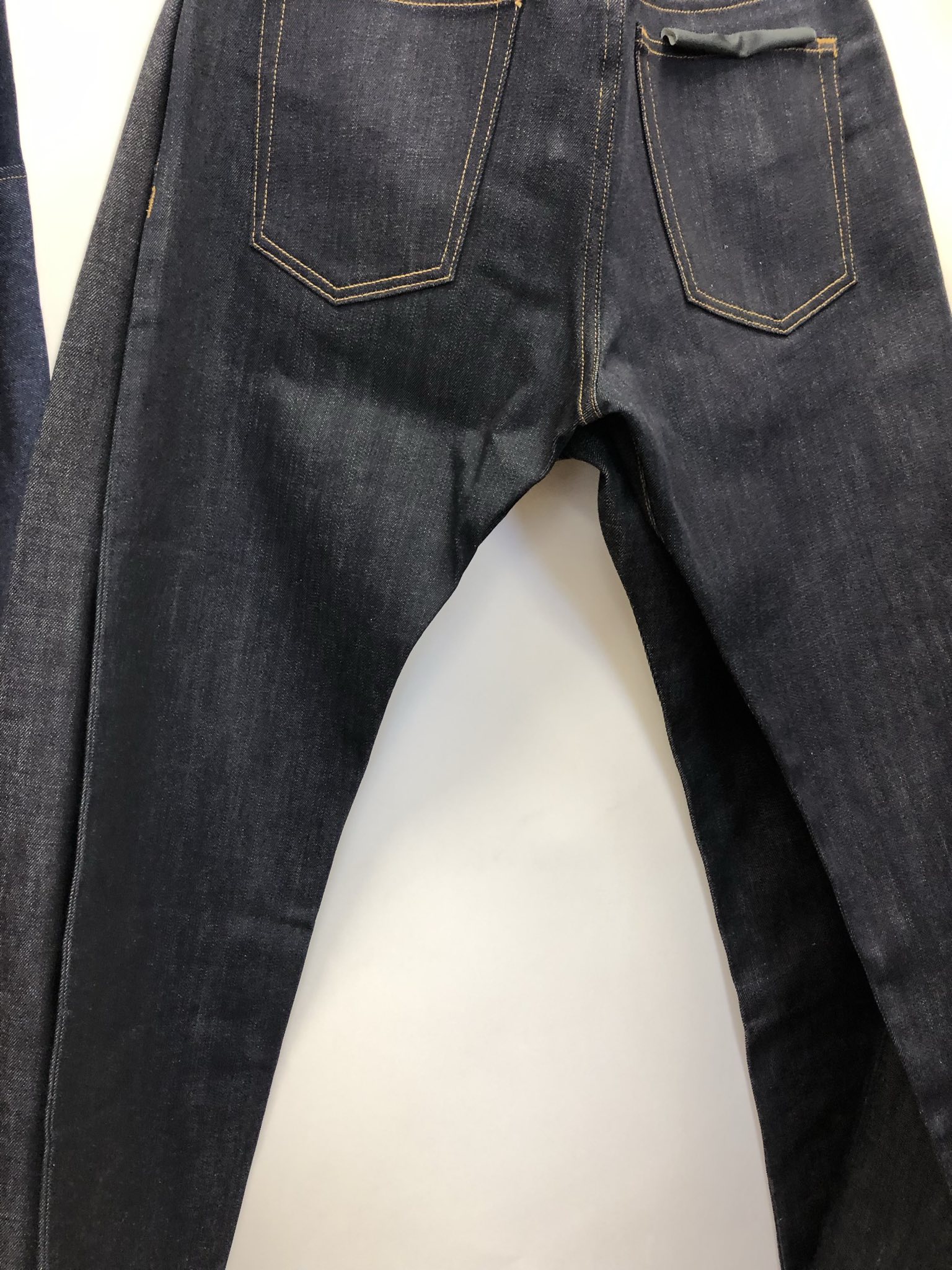
Then there’s the dye. A shirt finished with real indigo doesn’t merely look old as it ages. It fades the way raw denim fades, deepening and softening into a pattern that is specifically, only yours. That is the wabi-sabi Authentic Factory Loom tried to sell you at the door. You don’t buy it pre-installed. You earn it.
The $50 tee isn’t the point because everyone should spend $50 on a T-shirt. It’s the point because it lets you opt out of both extremes: the $7 landfill shirt and the $100 shirt coasting on a reputation it already moved to Portugal. It’s the honest middle.
Proof
The consumer, standing on Abbot Kinney with a slipped collar in hand, is saying two words. Prove the cotton is heavier. Prove the collar recovers. Prove the dye deepens instead of dies. Prove Made in Portugal or Made in Vietnam is a starting point for better questions, not a shortcut past them.
The test was never going to happen under boutique lighting, and it was never going to happen on a single day’s stock chart either. It happens at home. You wash it, wear it, sweat through it, fold it badly, reach for it again, and somewhere around the tenth wash the shirt tells you the truth the hangtag wouldn’t.
Maybe the future of the T-shirt isn’t luxury or landfill. Maybe it’s just the same thing cotton keeps getting asked for: proof in the seam.